TL;DR: MOTS-c is a 16-amino-acid peptide encoded inside the mitochondrial genome rather than in the cell's nuclear DNA — a finding that reframed the mitochondrion as a signalling organelle, not just a power plant. In preclinical work it activates AMPK, translocates to the nucleus under metabolic stress, and produces metabolic adaptations that overlap with those of exercise. The evidence base is cell and animal work; no human trials have been completed. Supplied for research use only.
What MOTS-c Is
MOTS-c stands for mitochondrial open reading frame of the 12S rRNA type-c — an unwieldy name that describes exactly where it comes from. It is a short peptide, 16 amino acids, whose coding sequence sits inside the mitochondrial genome.
Lee and colleagues identified it in 2015 in Cell Metabolism. The finding mattered less for the peptide itself than for where it was found, and understanding why requires a short detour into what mitochondria were assumed to be.
Why the Location Was the Discovery
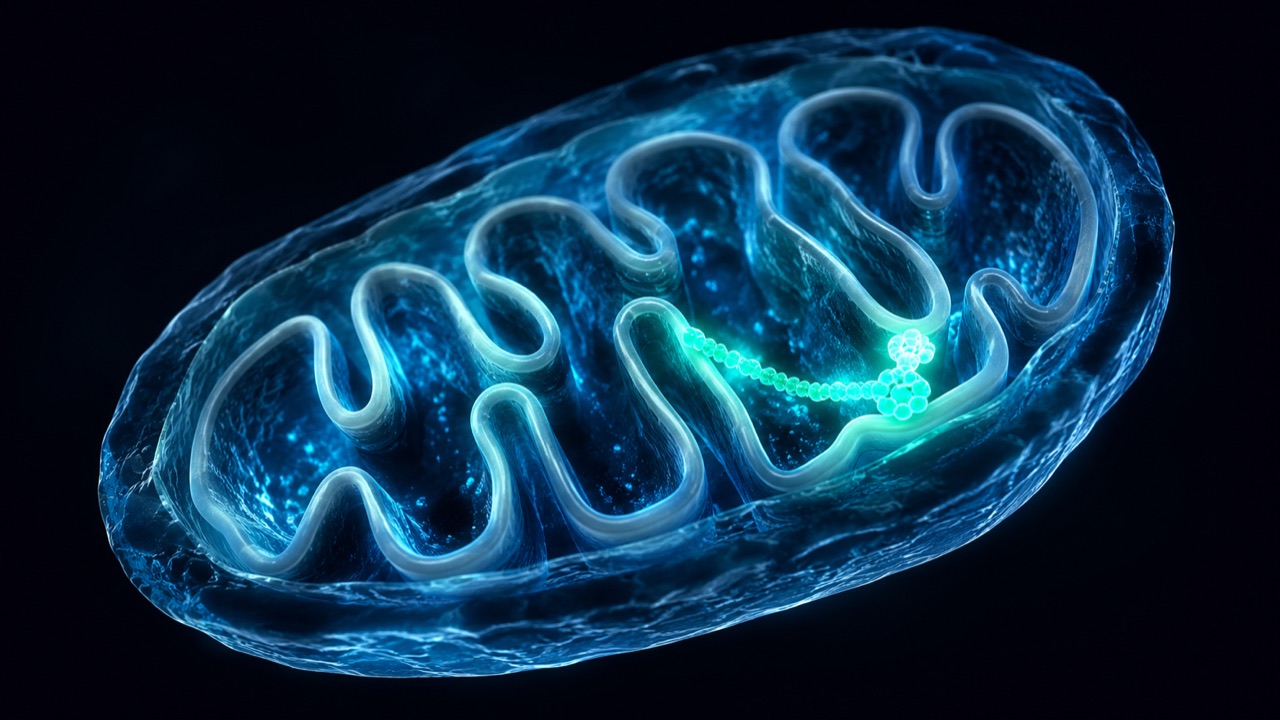
Mitochondria are descended from a free-living bacterium that was absorbed by an ancestral cell somewhere over a billion years ago. They kept a fragment of their own genome — a small circular piece of DNA, separate from the chromosomes in the nucleus.
That mitochondrial genome is tiny, and it was long understood to encode essentially one category of thing: components of the machinery that generates cellular energy. Structural parts for the power plant, in other words. The signalling that coordinates cellular behaviour was assumed to originate in the nucleus.
MOTS-c broke that assumption. A signalling peptide encoded in mitochondrial DNA means the organelle is not simply taking instructions — it is sending them. The mitochondrion reports on its own energetic state to the rest of the cell, and does so in the cell's own language.
The discovery reframed the mitochondrion from a power plant into something closer to a sensor with a voice: an organelle that measures energetic stress and signals the nucleus to adapt.
How It Works: AMPK and the Folate Pathway
The mechanism described in the published literature runs through two connected routes.
- AMPK activation. AMPK is the cell's primary energy sensor — it switches on when the ratio of spent to available energy currency rises, and it responds by promoting energy-generating processes and suppressing energy-consuming ones. MOTS-c activates it.
- The folate–purine pathway. MOTS-c intersects folate metabolism, and the reported consequence is accumulation of an intermediate that itself activates AMPK. The two routes converge rather than acting independently.
The more striking behaviour is what happens under stress. In the published work, metabolic stress causes MOTS-c to translocate to the nucleus, where it influences expression of stress-response and metabolic genes. A peptide encoded in one organelle physically relocating to another to change gene expression is unusual, and it is the part of the mechanism that draws the most research attention.
Downstream, animal-model work reports improved insulin sensitivity and shifts in which fuels tissue preferentially uses, particularly in skeletal muscle and fat tissue.
The Exercise Connection
MOTS-c is frequently described as an "exercise mimetic," and the phrase deserves unpacking because it is doing more work than the evidence supports.
What the literature reports is genuinely interesting: circulating MOTS-c levels rise with exercise, and administering MOTS-c to rodents produces metabolic adaptations that overlap with training adaptations. AMPK — the enzyme MOTS-c activates — is also a central node in how muscle responds to contraction. So the pathways genuinely intersect.
What the literature does not report is equivalence. Exercise drives mechanical loading, cardiovascular adaptation, neural adaptation, and dozens of signalling cascades that no single peptide reproduces. "Shares signalling pathways with exercise" is supportable. "Works like exercise" is not, and the gap between those two statements is where most of the overstatement in this topic lives.
MOTS-c and Aging Research
A second research thread connects MOTS-c to longevity. Mitochondrial function declines with age, and because MOTS-c is both encoded in and responsive to mitochondrial state, it became a natural candidate for aging research.
The most cited human-relevant finding is genetic rather than interventional: a specific variant in the MOTS-c coding region has been reported at differing frequencies in long-lived cohorts, which suggests the peptide sits somewhere on the pathway. That is an association in population genetics, not evidence that administering MOTS-c extends lifespan — a distinction routinely lost when this research is summarized.
The Mitochondrial-Derived Peptide Family
MOTS-c is not alone. It belongs to a small class known as mitochondrial-derived peptides (MDPs), all encoded within mitochondrial DNA.
| Peptide | Identified | Primary research focus |
|---|---|---|
| Humanin | 2001–2003 | Cytoprotection and neuronal survival — the first MDP described |
| MOTS-c | 2015 | Metabolic regulation, insulin sensitivity, exercise adaptation |
| SHLP1–6 | 2016 | A family of six; varied metabolic and cytoprotective roles |
The pattern across all of them supports the same conclusion: the mitochondrial genome contributes materially to cellular signalling, and the catalogue is probably incomplete. For adjacent mitochondrial research compounds, see our overviews of SS-31 (elamipretide) and NAD+, which approach mitochondrial function from different angles.
What Remains Unknown
The honest summary is that MOTS-c is a well-characterized mechanism with a thin outcomes record.
- No completed human trials. The evidence base is cell culture and animal models. Rodent metabolic findings have a poor historical track record of translating.
- Administration versus endogenous signalling. Whether supplying the peptide from outside reproduces what the body does when it releases its own, in a stress-triggered and localized way, is unresolved.
- No established dosing, kinetics, or safety profile in humans, because the trials that would produce them have not been run.
Handling and Storage
MOTS-c ships lyophilized and is reconstituted with bacteriostatic water, then refrigerated at 2 to 8 degrees Celsius. Lyophilized vials are stable frozen for long-term storage; avoid repeated freeze-thaw cycles once reconstituted. Our peptide storage guide covers stability in more detail, and the peptide reconstitution calculator converts any vial and diluent volume into syringe units.
Helix North supplies MOTS-C 10 mg and MOTS-C 20 mg as research materials, each with batch-specific HPLC purity verification. Our lab testing and CoA page covers the methodology.
For Research Use Only
Everything above describes cell-model and animal research on a compound with no completed human trials and no regulatory approval. Helix North supplies MOTS-c for research applications only — not for human or animal consumption, and nothing here constitutes medical, dosing, or clinical guidance.