TL;DR: BPC-157 and TB-500 act through entirely different mechanisms — one on angiogenesis and growth-factor signalling, the other on actin and cell migration. That non-overlap is why they are studied together, a pairing nicknamed the "Wolverine stack." The mechanistic rationale is genuinely sound; the evidence that the combination outperforms either alone is thin. Both are supplied for research use only.
Two Genuinely Different Mechanisms
The case for pairing these two rests entirely on how little they overlap, so the mechanisms are worth stating precisely.
BPC-157 is a 15-amino-acid fragment originally derived from a protein found in gastric juice. Published laboratory and animal work associates it with growth hormone receptor upregulation, nitric oxide signalling, and the formation of new blood vessels — an effect linked to the VEGFR2 receptor.
TB-500 is a synthetic fragment reproducing the active region of Thymosin Beta-4. Its mechanism runs through actin, the cytoskeletal protein. TB-500 binds individual actin monomers and changes how they assemble, which governs how cells move, divide, and specialize.
| BPC-157 | TB-500 | |
|---|---|---|
| Origin | Gastric protein fragment | Thymosin Beta-4 fragment |
| Acts on | Vascular and growth-factor signalling | Actin / cytoskeleton |
| Repair stage emphasized | Blood supply to the site | Cell migration into the site |
| Receptor-mediated? | Signalling-pathway mediated | Binds a structural protein, not a receptor |
Why Repair Stages Matter
Tissue repair is not a single event. It proceeds through overlapping phases — inflammation, then proliferation, then remodelling — and each has different rate-limiting steps.
A compound that improves blood supply addresses a different bottleneck than one that improves how cells migrate into the damaged area. Better perfusion does not help if cells cannot reach the site; better migration does not help if the tissue is poorly supplied.
The rationale for the pairing is not "two is better than one." It is that these two address different constraints, so increasing the dose of either would not substitute for adding the other.
That reasoning is genuinely sound, and it is a better argument than most combination protocols can offer.
What the Evidence Actually Shows
Here the honest answer diverges from the confident material circulating online.
Both compounds have individual preclinical literature. What is largely absent is controlled work directly comparing the combination against each compound alone — the study design that would actually establish synergy rather than assume it.
Without that comparison, three possibilities remain open: the effects are additive, they are genuinely synergistic, or one compound is doing most of the work and the other contributes little. The mechanistic story cannot distinguish between them.
So the accurate description is that this is a well-motivated hypothesis with a plausible mechanism, not a demonstrated result. That is a meaningful distinction, and it is the one most discussion of this pairing skips.
Where the Name Comes From
In peptide circles the combination is widely nicknamed the "Wolverine stack," after the comic character known for rapid healing. Searches for "wolverine peptide" or "wolverine BPC-157" are almost always looking for this pairing.
It is worth being clear that the nickname is colloquial shorthand only. It appears nowhere in the scientific literature, and it implies nothing about outcomes in humans — for whom neither compound has completed a trial.
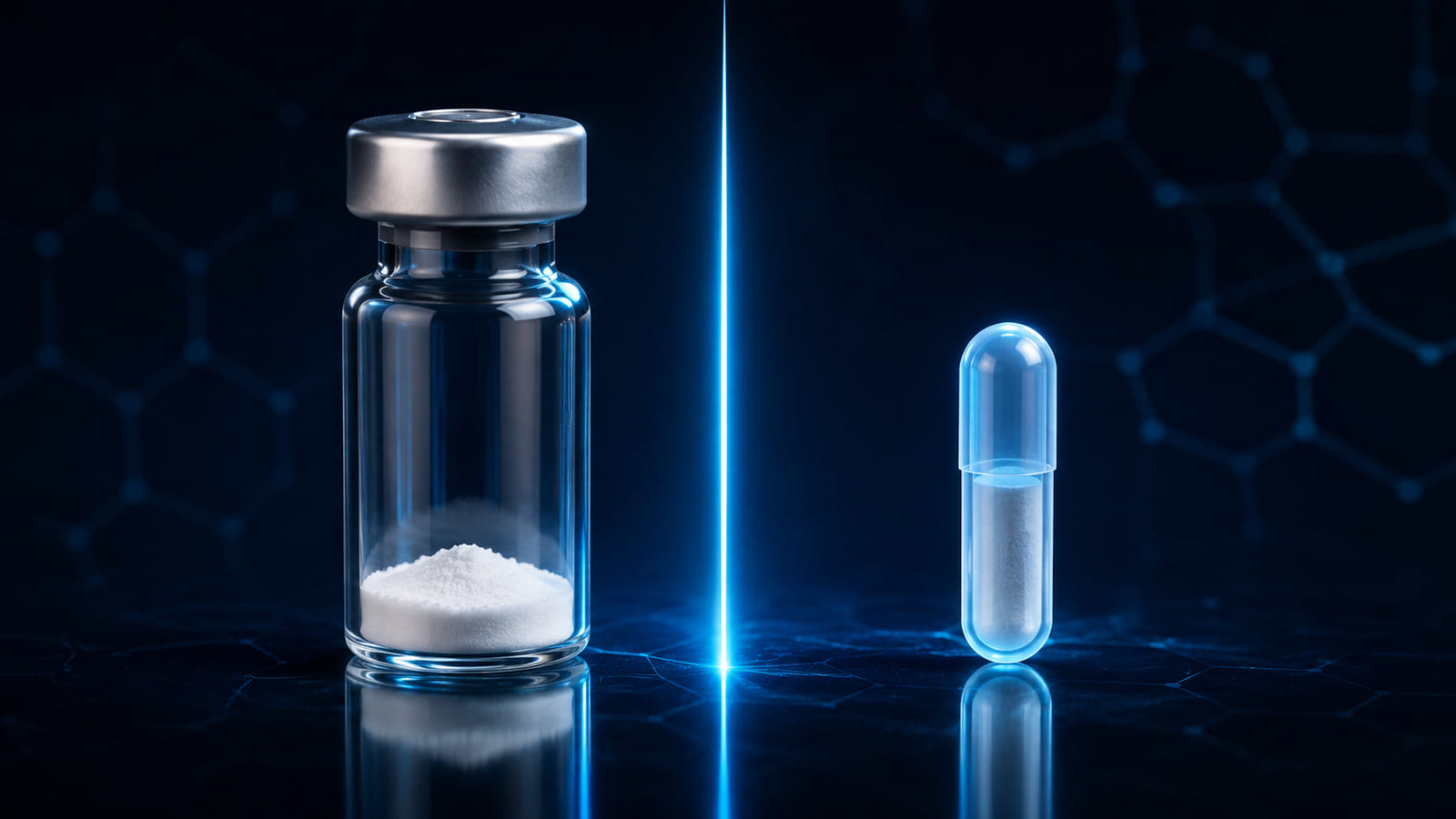
Separate Vials or Pre-Blended
BPC-157 and TB-500 are chemically distinct molecules, and in research they are typically stored, reconstituted, and handled separately. The reason is control: keeping them apart lets each compound's concentration and stability be verified independently, and if something goes wrong it is clear which component is responsible.
Pre-blended research vials exist for convenience and remove a reconstitution step, at the cost of that independent verification. Helix North stocks both compounds individually — BPC-157 10 mg and TB-500 10 mg — plus a pre-formulated BPC/TB 10/10 mg blend for researchers running combination protocols.
Handling
Both ship lyophilized and are reconstituted with bacteriostatic water, then refrigerated. Our step-by-step reconstitution guide covers the concentration math, the storage guide covers stability and freeze-thaw, and the reconstitution calculator handles any vial and diluent combination.
New to either compound? See our what is BPC-157 and what is TB-500 explainers, or the BPC-157 Canada and TB-500 Canada guides for forms, purity, and domestic sourcing.
For Research Use Only
Everything above describes preclinical laboratory research on compounds with no completed human trials and no regulatory approval. Helix North supplies these peptides for research applications only — not for human or animal consumption, and nothing here constitutes medical, dosing, or clinical guidance.