TL;DR: Bacteriostatic water (BAC water) is sterile water with 0.9% benzyl alcohol added as a preservative. That preservative is the whole point — it lets a single vial be drawn from repeatedly over weeks, which is why it is the standard diluent for reconstituting lyophilized research peptides. Add it slowly down the vial wall, swirl until clear, refrigerate at 2–8°C, and use within about 28 days. Everything below is for research handling, not human use.
What Is Bacteriostatic Water?
Bacteriostatic water is sterile water for injection with 0.9% benzyl alcohol added. The water provides the solvent; the benzyl alcohol provides the "bacteriostatic" property — it holds back the growth of bacteria and fungi so the vial does not become a contamination risk after the first puncture. It is a clear, colorless USP-grade solution, and in peptide work it serves one job: acting as the diluent that turns a freeze-dried (lyophilized) powder into a measurable liquid stock.
The role of 0.9% benzyl alcohol
Benzyl alcohol is the preservative that separates bacteriostatic water from plain sterile water. At 0.9% it is enough to suppress microbial growth across repeated draws without being the dominant component of the solution. This is what makes a multi-dose vial possible — the researcher can return to the same vial across many sessions rather than discarding it after one use.
Bacteriostatic water vs. sterile water vs. saline
| Diluent | Preservative | Best for |
|---|---|---|
| Bacteriostatic water | 0.9% benzyl alcohol | Multi-use vials drawn over days/weeks |
| Sterile water (SWFI) | None | Single-use — entire volume used at once |
| Bacteriostatic saline (0.9% NaCl) | Benzyl alcohol | Compounds that need an isotonic, salted diluent |
Why Bacteriostatic Water Is Used to Reconstitute Peptides
Lyophilized research peptides ship as a dry cake or pellet because they are far more stable dry than in solution. To work with one, it has to be returned to liquid — reconstituted — and the diluent chosen determines how long that solution stays usable.
Multi-dose vials: why "bacteriostatic" matters
Most research vials are drawn from more than once. A single retatrutide or BPC-157 vial often supports many sessions. Every time a needle passes through the rubber stopper there is a contamination opportunity; the benzyl alcohol in bacteriostatic water is what keeps the stock viable across all of those draws. Without a preservative, each puncture is a fresh risk.
When sterile water or saline is used instead
Sterile water for injection is appropriate only for single-use protocols where the entire reconstituted volume is consumed in one session — there is nothing left to contaminate. Bacteriostatic saline is occasionally chosen when a compound calls for an isotonic, salted carrier. For the typical multi-draw research vial, bacteriostatic water is the default.
How to Reconstitute a Peptide with Bacteriostatic Water
The technique is the same gentle protocol used across freeze-dried research peptides. For compound-specific walkthroughs, see our retatrutide reconstitution guide and BPC-157 reconstitution guide.
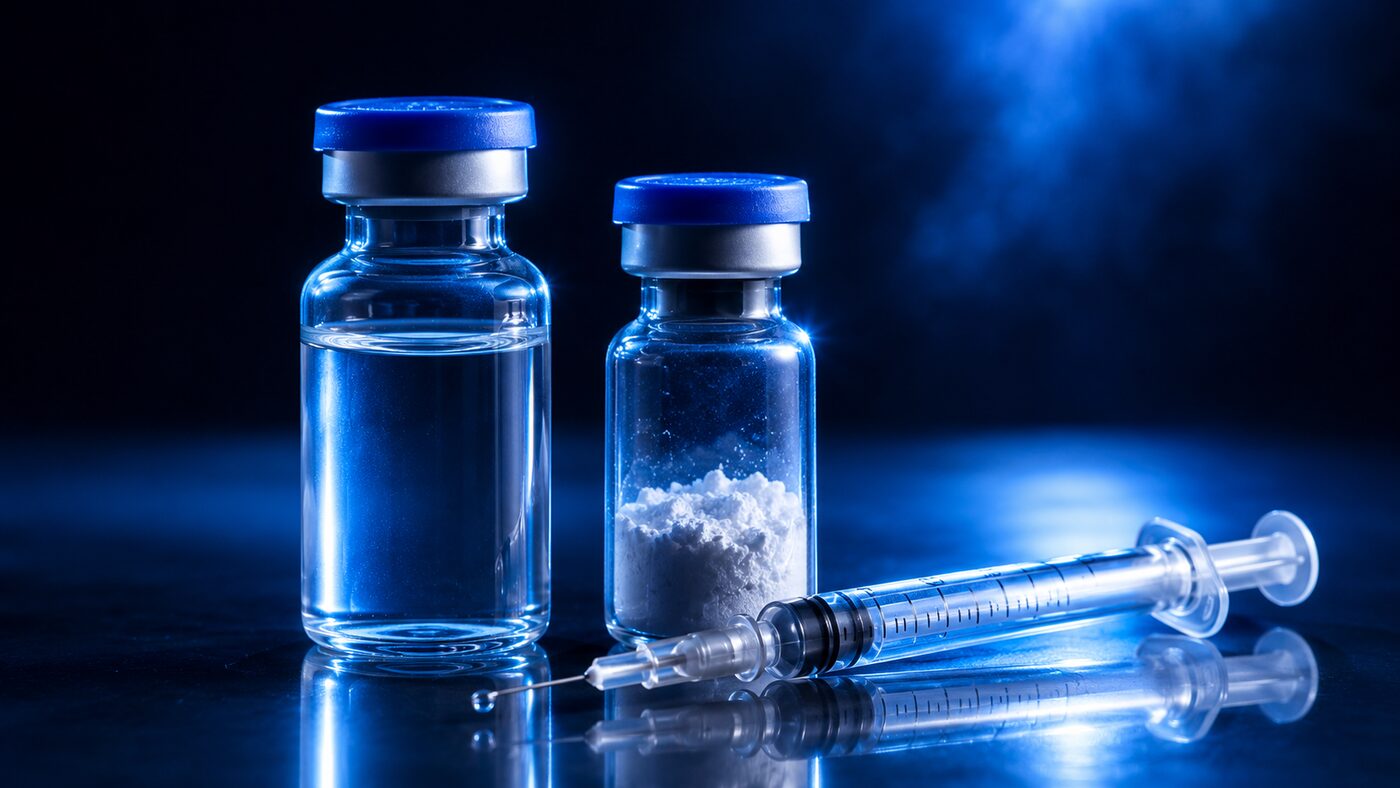
What you need
- The lyophilized peptide vial
- A vial of bacteriostatic water
- A sterile syringe and alcohol prep pads
Step by step
- Let both vials reach room temperature if pulled from refrigeration (10–15 minutes).
- Wipe both rubber stoppers with an alcohol prep pad.
- Draw the chosen volume of bacteriostatic water into the syringe.
- Insert the needle at an angle so the liquid runs down the inner glass wall, not directly onto the powder cake.
- Inject slowly. Then swirl gently — do not shake — until the solution is completely clear.
- Inspect: the result should be clear and colorless. Cloudiness or particulate means discard, not rescue.
Worked example: a 10 mg vial
Reconstitute a 10 mg vial with 2 mL of bacteriostatic water and you have a 5 mg/mL stock. On a 100-unit insulin syringe (each unit = 0.01 mL), that is 0.05 mg per unit. Use 4 mL instead and the stock is 2.5 mg/mL — every draw volume doubles to deliver the same amount. Our peptide reconstitution calculator works this out for any vial, diluent volume, and target dose.
How Much Bacteriostatic Water Do You Need?
The concentration of the reconstituted stock equals the peptide mass in the vial divided by the volume of bacteriostatic water added. The mass never changes — only the concentration does.
- 10 mg ÷ 1 mL = 10 mg/mL
- 10 mg ÷ 2 mL = 5 mg/mL
- 10 mg ÷ 4 mL = 2.5 mg/mL
Adding more bacteriostatic water gives a lower concentration but the same total peptide. Pick the volume that makes downstream sampling cleanest, and write the concentration on the vial label.
Storing Bacteriostatic Water and Reconstituted Peptides
Unopened bacteriostatic water is stored at room temperature and follows its printed expiry. Once punctured, the benzyl alcohol preservative supports roughly 28 days of multi-draw use when refrigerated at 2–8°C. Reconstituted peptide stock belongs in the fridge as well — never the freezer, since freeze-thaw cycles degrade many peptides. For the full handling protocol, see our peptide storage and handling guide.
Where to Buy Bacteriostatic Water in Canada
Helix North supplies bacteriostatic water in Canada as a companion to the peptide catalog, shipped domestically by Canada Post Xpresspost — no customs, flat-rate shipping, delivered nationwide including Toronto, Calgary, Edmonton, and rural postal codes. Two sizes cover most research needs: the 10 mL vial for smaller-volume protocols and the 30 mL vial for multi-compound or longer-running work. Both are reconstitution diluents for the lyophilized peptides across our GLP research line and the wider Canadian research peptide catalog.
Related Reading
- How to Reconstitute Retatrutide — diluent selection, concentration math, and the draw-volume table.
- How to Reconstitute BPC-157 — the same procedure for a tissue-repair peptide.
- Peptide Storage & Handling — shelf life, refrigeration, and freeze-thaw.
- BAC Water 30 mL — USP-grade bacteriostatic water, shipped from Canada.
For Research Use Only
Everything above describes in-vitro and laboratory research handling. Helix North supplies bacteriostatic water and all peptides strictly for research applications, not for human or animal use.