TL;DR: Stability is the hidden variable that quietly breaks reproducibility. Two labs running an identical protocol on identical compound can get different results if one stored the vial badly. The rules are simple and cheap: keep dry powder frozen, refrigerate after reconstitution, aliquot before freezing so nothing gets cycled repeatedly, and protect light-sensitive compounds from light.
Why Storage Is a Reproducibility Problem
Degradation is insidious because it is usually invisible. A peptide that has lost a third of its activity generally looks identical to one that has lost none. There is no colour change, no smell, no precipitate — just a quietly weaker result that gets attributed to biology rather than handling.
This is why storage discipline belongs in the protocol rather than in the general-tidiness category. An experiment that fails because of a degraded vial does not announce the reason.
Dry Powder vs Reconstituted
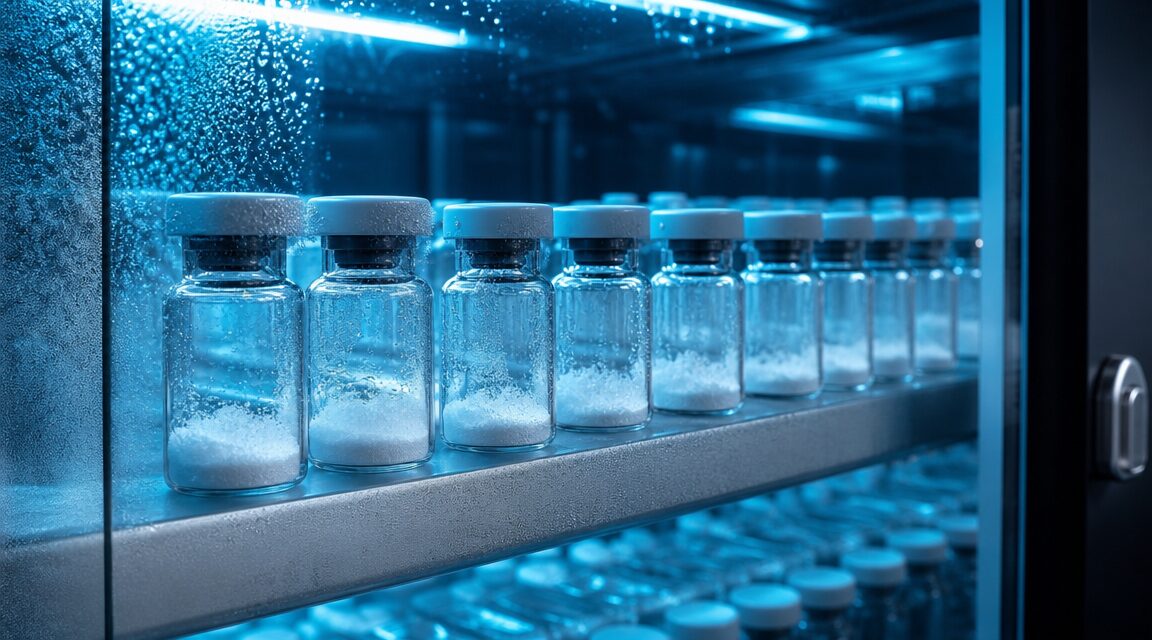
Freeze-dried (lyophilized) peptide is by a wide margin the most stable form. Removing the water removes the medium in which most degradation reactions occur — hydrolysis, oxidation, and microbial growth all need it. Once you add diluent, the clock speeds up sharply.
| State | Temperature | Typical stability |
|---|---|---|
| Lyophilized | -80°C | 24+ months |
| Lyophilized | -20°C | 12–24 months |
| Lyophilized | Room temperature | Weeks, for transit purposes |
| Reconstituted | 2–8°C (fridge) | 30–60 days for most peptides |
| Reconstituted | Room temperature | Hours to a few days |
The practical consequence: reconstitute only what you will actually use in the coming weeks, and leave the rest as powder. Reconstituting an entire stock because it is convenient is the most common avoidable loss in peptide work.
Freeze-Thaw Cycles
Every freeze-thaw cycle stresses the peptide — aggregation, oxidation, partial chain breakdown. The damage accumulates per cycle, largely independent of how long the material spent frozen in between.
A vial put through ten freeze-thaw cycles loses substantially more activity than a vial frozen and thawed once, even when total time at -20°C is identical. The cycles do the damage, not the storage.
The fix is aliquoting: split the reconstituted vial into small single-use portions and freeze each separately. Each aliquot then sees exactly one thaw. It takes a few minutes once and protects the entire stock, which makes it the highest-return habit available in peptide handling.
Light Sensitivity
Some compounds degrade under light. NAD+ is a notable example, as are certain tryptophan-containing peptides, which are vulnerable to UV and even sustained fluorescent exposure.
The defences are trivially cheap: amber vials, foil wrapping, or simply a dark drawer. Light protection costs essentially nothing, while ruined stock costs the experiment plus the reorder. When in doubt, store dark — there is no compound that is harmed by it.
Sterility and Contamination
Bacteriostatic water contains benzyl alcohol, which suppresses microbial growth. It does not sterilize, and it will not rescue a solution that has already been contaminated. Aseptic technique on every draw remains necessary:
- Wipe the vial septum with an isopropyl alcohol pad before every draw, not just the first.
- Use a fresh sterile needle for each withdrawal — never re-enter a vial with a used needle.
- Inspect visually before use and discard anything cloudy or showing particulates.
Receiving and Transit
Most freeze-dried research peptides tolerate ambient shipping temperatures for several days without measurable activity loss. This is precisely why peptides ship as dry powder — the lyophilized form is robust enough that a cold chain is unnecessary in transit.
On arrival, move vials to frozen storage promptly if they will not be reconstituted immediately. Refrigeration becomes essential after reconstitution, or for liquid products such as bacteriostatic water.
Compound-Specific Notes
- NAD+ is more light-sensitive and less solution-stable than most peptides. Protect from light and use reconstituted material promptly — see our NAD+ overview.
- Small molecules such as 5-Amino-1MQ are considerably more forgiving than peptides and tolerate room-temperature storage as dry powder.
- GLP-class peptides follow the standard pattern — frozen as powder, refrigerated once reconstituted. Our reconstitution guide covers the procedure.
A Practical Checklist
- Store lyophilized vials frozen; reconstitute only what near-term work requires.
- Add diluent slowly down the vial wall and swirl — never shake.
- Aliquot before freezing reconstituted material.
- Store dark by default.
- Fresh needle and an alcohol wipe on every draw.
- Label aliquots with compound, concentration, and date — undated material is unusable material.
The peptide reconstitution calculator handles the concentration math for any vial and diluent combination, and our lab testing and CoA page covers how each lot is verified before it ships.
For Research Use Only
The handling practices above are laboratory procedures for research materials. Helix North supplies peptides for research applications only — not for human or animal consumption, and nothing here constitutes medical, dosing, or clinical guidance.