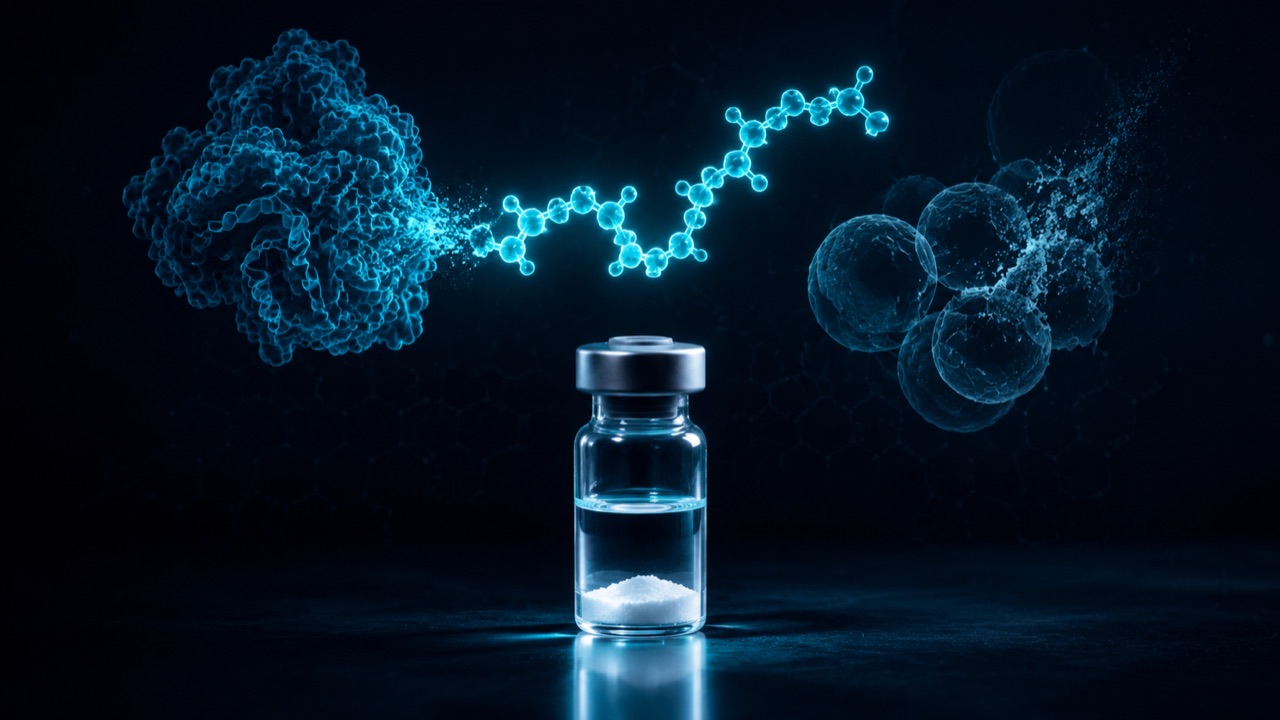
TL;DR: NAD+ is a coenzyme in every cell, required for energy production, the sirtuin enzymes, and DNA repair. Levels fall with age because consumption rises and production falls simultaneously. Because NAD+ itself crosses cell membranes poorly, most research uses precursor molecules the cell converts internally. Human trials confirm precursors raise NAD+ levels; whether that produces the functional benefits seen in animals is unresolved. Research use only.
What NAD+ Is
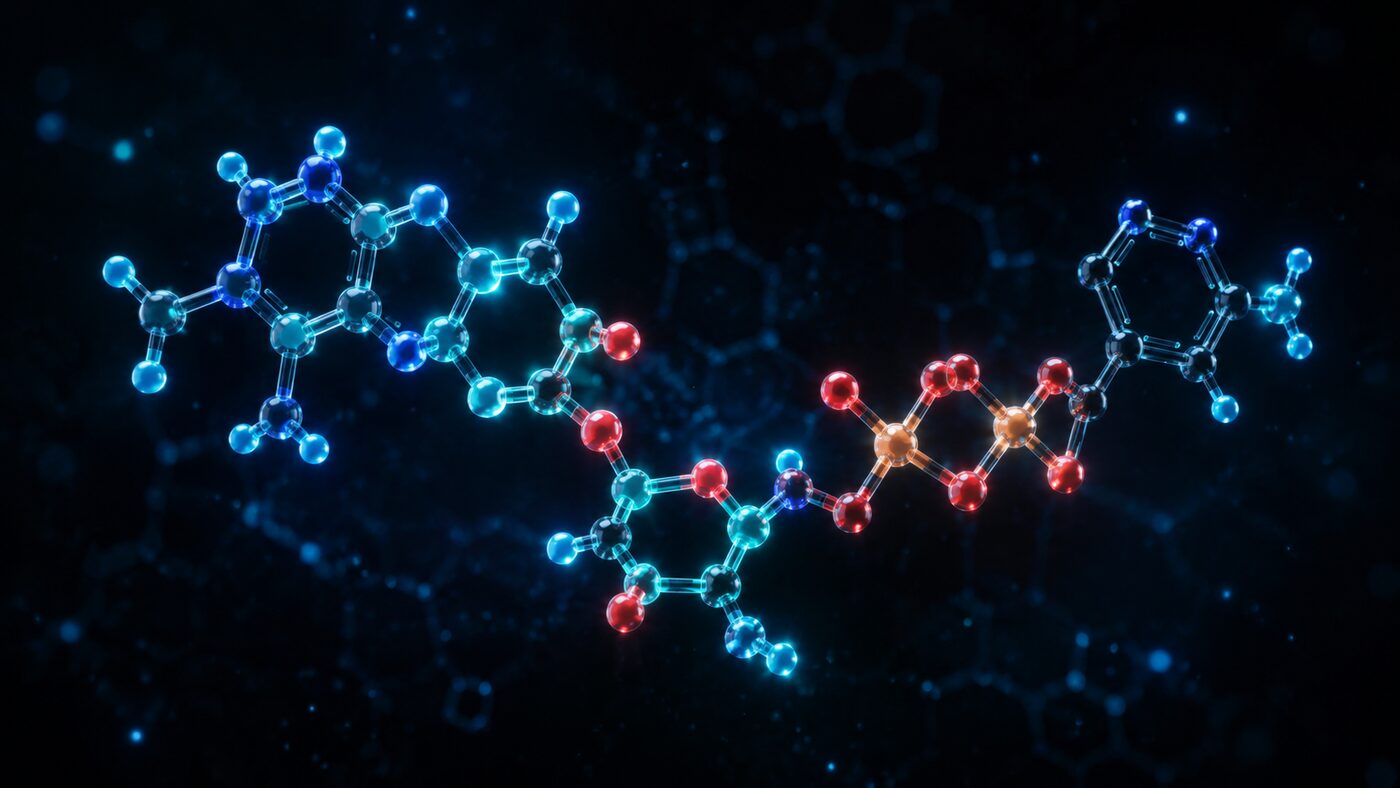
Nicotinamide adenine dinucleotide (NAD+) is a coenzyme — a helper molecule — present in every living cell. It is not a peptide, and it is not a signalling molecule in the way most compounds discussed here are. It is closer to infrastructure: a component so many reactions depend on that its availability constrains what the cell can do.
What It Actually Does
NAD+ has three distinct jobs, and conflating them causes most of the confusion in this area.
- Electron carrier. It shuttles electrons through the reactions of energy metabolism, cycling between NAD+ and NADH. This is the classical biochemistry role and it is catalytic — the molecule is recycled, not consumed.
- Sirtuin cofactor. The sirtuin enzymes require NAD+ to function. Unlike the electron-carrier role, this one consumes NAD+.
- PARP substrate. The PARP enzymes that repair DNA damage also consume NAD+ as raw material.
That split matters. The first role recycles; the latter two burn through the pool. So anything that increases DNA damage or sirtuin activity draws down the same reserve that energy metabolism depends on.
Why NAD+ Declines With Age
Cellular NAD+ levels drop measurably as tissues age, and the decline is driven from both directions at once:
- Consumption rises. The CD38 and PARP enzyme families become more active with age and chronic inflammation, and both burn NAD+ as they work.
- Production falls. The salvage-pathway enzymes that rebuild NAD+ become less efficient over time.
The functional consequences propagate through mitochondrial energy production, sirtuin-controlled gene expression, and the cell's capacity to repair oxidative damage — which is why NAD+ became one of the most active areas in metabolic and aging research.
The Delivery Problem
Here is the practical obstacle that shapes the entire field, and the reason "NAD+ injection" is such a common search.
NAD+ is a relatively large, charged molecule. It does not cross cell membranes efficiently. Delivering NAD+ itself — orally or systemically — does not reliably raise concentrations inside cells, which is where the enzymes that need it actually operate. Raising a level in the bloodstream is not the same as raising it in the mitochondria.
This is why most research strategies use precursors instead: smaller molecules with dedicated cellular transporters, which the cell converts into NAD+ internally.
| Molecule | Steps to NAD+ | Research note |
|---|---|---|
| Nicotinamide riboside (NR) | Two enzymatic steps | Enters cells via dedicated transporters |
| Nicotinamide mononucleotide (NMN) | One step | Heavily studied; uptake mechanism debated |
| NAD+ direct | None — already the product | Poor membrane permeability is the limiting factor |
Which precursor is superior is genuinely contested rather than settled, and confident claims in either direction generally outrun the data.
The Sirtuin Connection
Sirtuins (SIRT1 through SIRT7) are enzymes that require NAD+ as a cofactor. They influence gene expression, mitochondrial biogenesis, and stress-response pathways.
The well-known link between calorie restriction and extended lifespan in animal models runs partly through sirtuin activation — which in turn depends on adequate NAD+. This is the chain of reasoning behind most NAD+ longevity interest, and it is worth noting it is a chain: several inferential steps, each individually reasonable, compounding into a conclusion stronger than any single link supports.
What the Human Evidence Shows
Being precise here is worthwhile, because this is where the topic is most oversold.
What is established: precursor supplementation does raise measurable NAD+ levels in humans. Multiple trials confirm this. The biochemistry works.
What is not established: that raising those levels produces the functional and physiological benefits observed in animal models. Human outcome data have been considerably more mixed than the mechanistic story predicts.
Raising a biomarker is not the same as improving an outcome. NAD+ research has reliably achieved the former; the latter remains an open and intensively studied question.
Related Research Compounds
Several compounds approach the same territory from different angles. 5-Amino-1MQ inhibits NNMT, an enzyme that consumes an NAD+ precursor — preserving the pool rather than supplying it. MOTS-c is a mitochondrial-derived peptide acting on AMPK. SS-31 (elamipretide) targets mitochondrial membrane function directly. They are complementary lines of inquiry into the same underlying problem.
Handling and Storage
NAD+ ships lyophilized and is reconstituted with bacteriostatic water. It is more demanding than most peptides in one respect: it is notably light-sensitive and less stable in solution. Protect reconstituted material from light, refrigerate it, and avoid repeated freeze-thaw cycles. Our storage guide covers stability, and the reconstitution calculator handles the concentration math.
Helix North supplies NAD+ 500 mg for laboratory research, with a third-party Certificate of Analysis published on its product page — see our lab testing and CoA page for methodology.
For Research Use Only
Everything above describes laboratory and clinical research. Helix North supplies NAD+ for research applications only — not for human or animal consumption, and nothing here constitutes medical, dosing, or clinical guidance.