TL;DR: Nobody can honestly name the single best BPC-157 in Canada, because no authority tests or ranks research peptides. What you can do is judge suppliers on five things you can actually verify: a published third-party certificate of analysis, a real purity number, domestic shipping, a price that makes sense per milligram, and research-only positioning. We are a supplier, so hold us to the same five.
Search “BPC-157 for sale” and you'll find dozens of vendors at wildly different price points. This is a criteria checklist for telling them apart — written for Canadian researchers sourcing laboratory material, not a ranked list of brands.
Why “Best” Is the Wrong Question
Because research peptides aren't regulated as drugs, there is no regulator, no standards body and no independent lab publishing league tables. Any page claiming to rank the best BPC-157 is either ranking on affiliate commission or ranking itself.
The question that does have an answer is narrower: which suppliers document what they sell? That is verifiable before you spend anything, and it is what the rest of this guide is about.
What “Quality” Actually Means
For a research peptide, quality comes down to two questions: is it the right molecule, and how much of the sample is that molecule versus impurities, truncated sequences, or fillers. A vendor that can't answer both — with documentation, not marketing copy — hasn't earned your order.
This matters more than it sounds. Lyophilised peptide is a white powder; a vial of 99% BPC-157 and a vial of something else look identical. There is no visual inspection that helps you.
1. Certificate of Analysis (Per Batch)
The single most important signal is a certificate of analysis (CoA) you can read before you buy. A credible CoA shows identity confirmed by mass spectrometry and purity measured by HPLC, with the chromatogram and lot number included. A supplier that will not show you one at all, or only produces it after payment, is asking for trust it has not earned. On Helix North product pages the CoA is published openly where we hold one; see our lab testing and CoA page for how each batch is verified.
2. A Real Purity Number
Look for a stated purity of ≥99% by HPLC, backed by the chromatogram on the CoA. Be wary of vendors who advertise purity in words (“pharmaceutical grade,” “ultra pure”) but never attach a number or a test. Purity that can't be reviewed before ordering isn't a specification — it's a claim.
3. Domestic (Canadian) Sourcing
A Canadian-domestic supplier removes two headaches that come with offshore orders: the customs wait and the currency markup. A shipment that never crosses a border can't be held or returned at the border mid-project, and pricing in Canadian dollars means the number on the product page is the number on your receipt. Our Canadian research peptides overview covers domestic shipping and testing in more depth.
4. A Price That Makes Sense
Compare on cost per milligram, not headline price. Vendors sell single vials, half kits and full kits, and those numbers aren't directly comparable until you divide by the total peptide they contain.
Once normalised, treat a price far below the market as information rather than a bargain. Synthesis, HPLC purification and third-party testing cost roughly the same for everyone, so a large discount has to come from somewhere — usually an underfilled vial, a lower-purity batch, or testing that never happened. Equally, a high price is not evidence of quality on its own. It only means something when the CoA backs it.
What Separates a Documented Supplier From a Reseller
| Signal | Documented supplier | Reseller |
|---|---|---|
| CoA | Published on the page, chromatogram included | Furnished on request, or none |
| Purity | A number you can check before ordering | Adjectives only |
| Identity testing | Mass spectrometry on the batch | Not mentioned |
| Shipping | Domestic, tracked, priced in CAD | Offshore, customs risk, USD |
| Positioning | Research use only, stated plainly | Hints at human use |
| Contactability | A real company you can reach | A form that goes nowhere |
How to Read BPC-157 Reviews
Reviews are the most-searched shortcut here and the least reliable one, so it's worth being precise about what they can and can't tell you.
On-site reviews are collected, filtered and displayed by the vendor being reviewed. That isn't necessarily dishonest, but it isn't independent either.
Forum and Reddit reports are more independent and carry a different problem: they describe material whose contents were never verified. If nobody tested the vial, a reported effect can't be attributed to BPC-157 at all — the same evidentiary hole covered in our piece on BPC-157 side effects.
What reviews genuinely are good for is the operational side, which no CoA covers:
- Did it ship when they said it would, and arrive intact?
- Did the CoA match the lot number on the vial that turned up?
- Did anyone answer when something went wrong?
- Was the packaging appropriate for the material?
Treat a review profile with only five-star ratings, no operational detail, and no verified purchases the same way you'd treat a purity claim with no number behind it.
Which Form Is Best for the Work
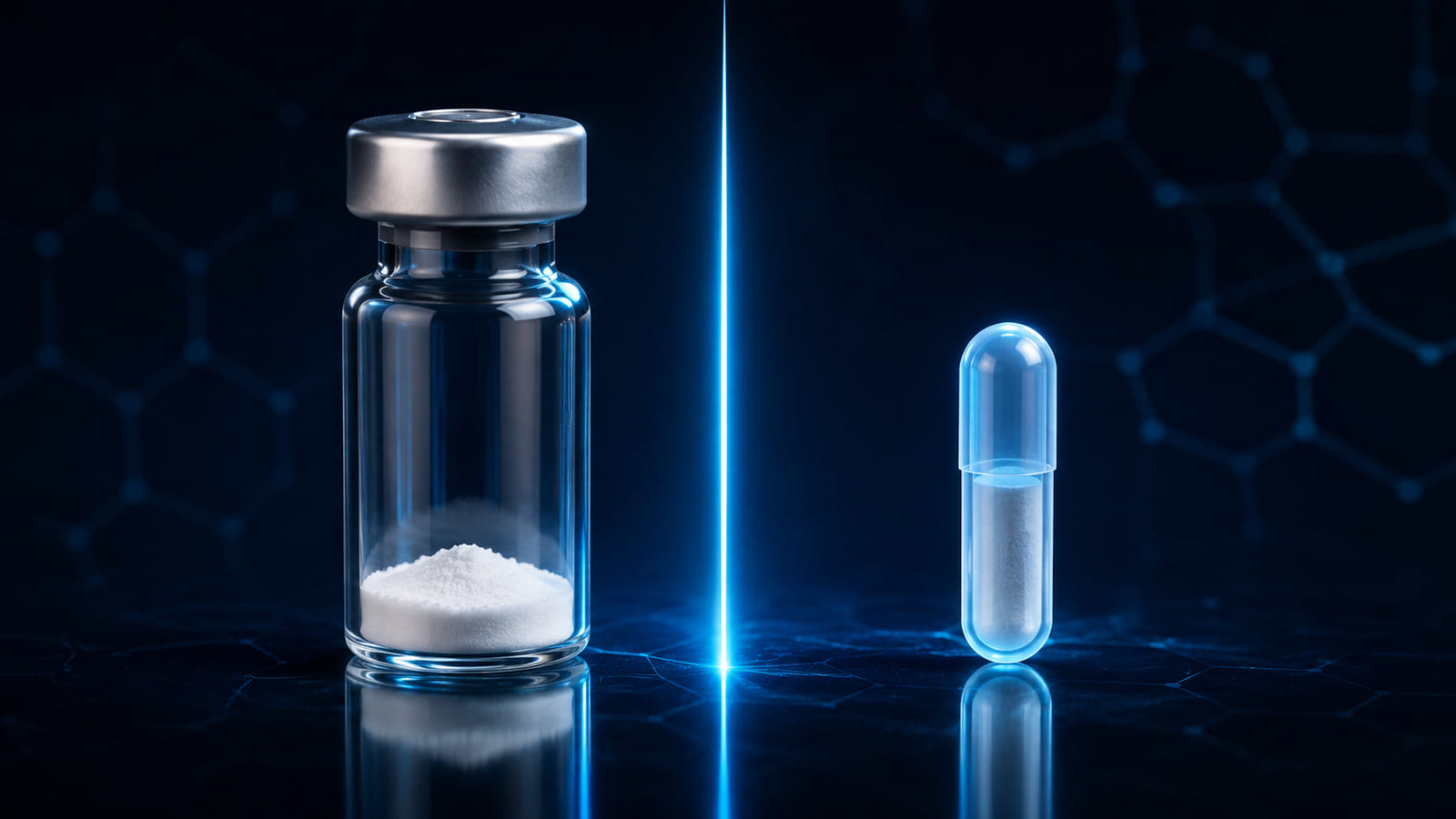
BPC-157 is most commonly supplied as a lyophilised vial for reconstitution, which gives the most control over concentration — see our reconstitution guide for the method and the units chart for the conversions. Capsules trade that control for a fixed amount and no preparation.
Neither is established as superior — no study has compared them — so the choice follows the protocol rather than the marketing. Our oral vs injection comparison covers the trade-offs in full. The purity and documentation criteria apply identically to both.
Red Flags
- No certificate of analysis, or a CoA that's identical across every product.
- Purity claimed in adjectives, never in numbers.
- Marketing that frames the compound for human use — a research supplier sells research material only.
- Vague or hidden sourcing, no company information, no way to contact a person.
- Prices far below the market with no explanation.
- A domain impersonating an established supplier's name with a different extension.
The Short Checklist
- Third-party CoA with HPLC + mass spec you can review before ordering?
- Stated purity ≥99% you can review before ordering?
- Ships from inside Canada, priced in CAD?
- Cost per milligram in line with the market?
- Sold strictly as a research material?
- Real company, reachable, transparent sourcing?
Judging Us by the Same List
We sell BPC-157, so treating this guide as neutral would be naive — apply the checklist here first. Our CoAs are published on the product page where we hold one, readable before you order rather than furnished on request, purity is stated as a number with the chromatogram attached, orders ship domestically in CAD, and everything is sold as research material only.
Those are checkable claims, which is the point. See the BPC-157 10 mg listing for current pricing and batch documentation, the BPC-157 Canada guide for the full picture, or what BPC-157 is if you're still deciding whether it fits the research at all.
For Research Use Only
Helix North supplies BPC-157 strictly for laboratory and in-vitro research — not for human or veterinary consumption. Nothing here is dosing, safety or medical guidance.