TL;DR: The honest answer is that nobody has a verified list. BPC-157 has never completed a large human trial, so the side-effect lists you find online are pieced together from rodent studies and unverified self-reports. Animal toxicology work reported no toxic dose. Regulators still moved against it: WADA banned it in sport from 2022, and in 2023 the FDA placed it in a category for substances with insufficient safety data. Everything below is research context. BPC-157 is supplied for laboratory research only, not for human consumption.
Why There Is No Real Side-Effect List
Because the human trials were never run at scale. That single fact explains most of the confusion around this peptide.
Compare it with a compound like retatrutide, where a published Phase 2 trial counted adverse events across hundreds of participants at defined doses. That is what a side-effect profile looks like when it exists. Our retatrutide side effects piece can lean on real numbers. For BPC-157, there is no equivalent dataset.
There was one clinical programme. In the 1990s and 2000s a Croatian pharmaceutical company studied the peptide under the code PL 14736 for inflammatory bowel disease. It reached early-phase human testing and was described as well tolerated, but it never progressed to the large trials that would have produced a proper safety label.
Any confident list of "BPC-157 side effects" is telling you more about the confidence of the writer than about the evidence.
What the Animal Studies Report
Most of the BPC-157 literature comes from one research group in Zagreb, working across several decades and dozens of rodent models. The finding they report most often on the safety side is a negative one: in their toxicology work, no lethal or toxic dose was reached.
That is a genuine result, and it is why the peptide has the reputation it has. It also has hard limits. Animal toxicology at study doses does not establish human safety, one group's body of work is not the same as independent replication, and "no toxicity observed" is not the same as "no effects to worry about."
Kidneys, Liver, Blood Pressure: The Questions People Search
These three come up constantly in search, and the answer is the same for all of them. No human dataset shows organ damage from BPC-157, because no human dataset exists.
What the animal literature actually shows is close to the opposite of the fear. Kidney injury, liver injury and blood-pressure models are settings where researchers deliberately studied BPC-157 as a protective agent. In rat work on both high and low blood pressure, it was reported to moderate the extremes rather than drive pressure one way.
Read that carefully, though. "Studied as protective in rats" is not a safety claim for people. It means the research question was pointed in a different direction from the one the search term assumes.
Is It a Steroid?
No. BPC-157 is a chain of 15 amino acids, originally identified in a protein found in human gastric juice. Anabolic steroids are a different class of molecule entirely, working through hormone receptors. The two have nothing in common beyond both being used by people who lift.
The confusion probably comes from sport. WADA added BPC-157 to its Prohibited List with effect from January 2022, under the category covering substances with no approval from any health authority. So it is banned in tested competition, but as an unapproved substance, not as a steroid.
What Regulators Have Actually Said
This is the clearest official signal available, and it is worth stating plainly rather than burying.
- FDA, 2023. BPC-157 was placed in Category 2 of the agency's review of bulk drug substances for compounding — the category for substances carrying significant safety risks or lacking sufficient data. That decision took it out of US compounding pharmacies.
- WADA, 2022. Added to the Prohibited List as a non-approved substance, banned at all times in tested sport.
- Health Canada. Not approved as a drug or a natural health product. In Canada it is legitimately available only as a research material.
None of these say harm has been proven. They say safety has not been established. That is the accurate reading, and it is the reason this peptide is sold for research rather than consumption.
Do Men and Women Report Different Effects?
No research establishes a difference. Both "BPC-157 side effects women" and "BPC-157 side effects men" are heavily searched, and neither has a study behind it. Answering the question would take a controlled trial large enough to split by sex, and that trial has not been run.
What About Oral Versus Injectable?
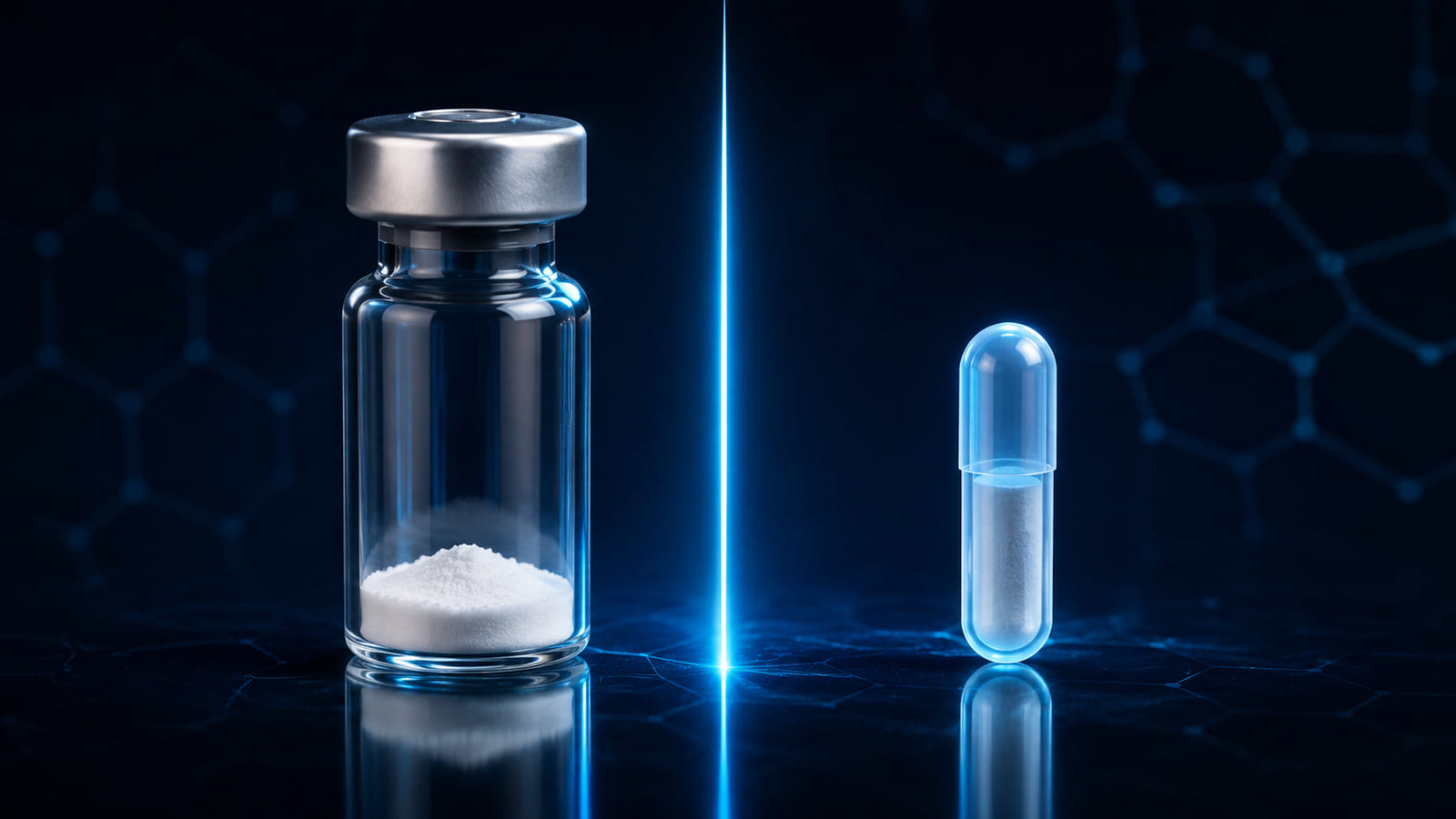
Oral forms exist because of an unusual property: BPC-157 is reported to stay stable in gastric acid, where most peptides are destroyed. That is why capsule forms are on the market at all alongside lyophilised vials.
On side effects specifically, there is no comparative human data for either route. Nobody has run the study that would let you say one is better tolerated than the other.
How to Read the Anecdotes
A large share of BPC-157 side-effect searches end up on forums, so it is worth being straight about what those reports are worth. They are uncontrolled, unblinded, self-selected, and — the part people forget — based on material of unverified content.
That last point matters more than it sounds. If a vial's actual contents were never verified, a reported effect cannot be attributed to BPC-157 at all. It could be a different peptide, a different amount, or a contaminant. This is the practical reason to care about a batch certificate of analysis and HPLC purity, and our guide to choosing a BPC-157 supplier in Canada covers what to check.
The Honest Summary
BPC-157 sits in an awkward gap. Thirty years of animal research reported no toxicity. No human trial ever confirmed that at scale. Two regulators have formally noted the missing data. All three of those statements are true at once, and anyone telling you the picture is settled in either direction is overselling it.
For background on the peptide itself and the mechanisms behind the research, see what BPC-157 is, or the overview of BPC-157 in Canada.
For Research Use Only
Everything above describes published laboratory and clinical research. Helix North supplies BPC-157 for in-vitro and laboratory research only — not for human or veterinary consumption, and nothing here is safety, dosing or medical guidance.