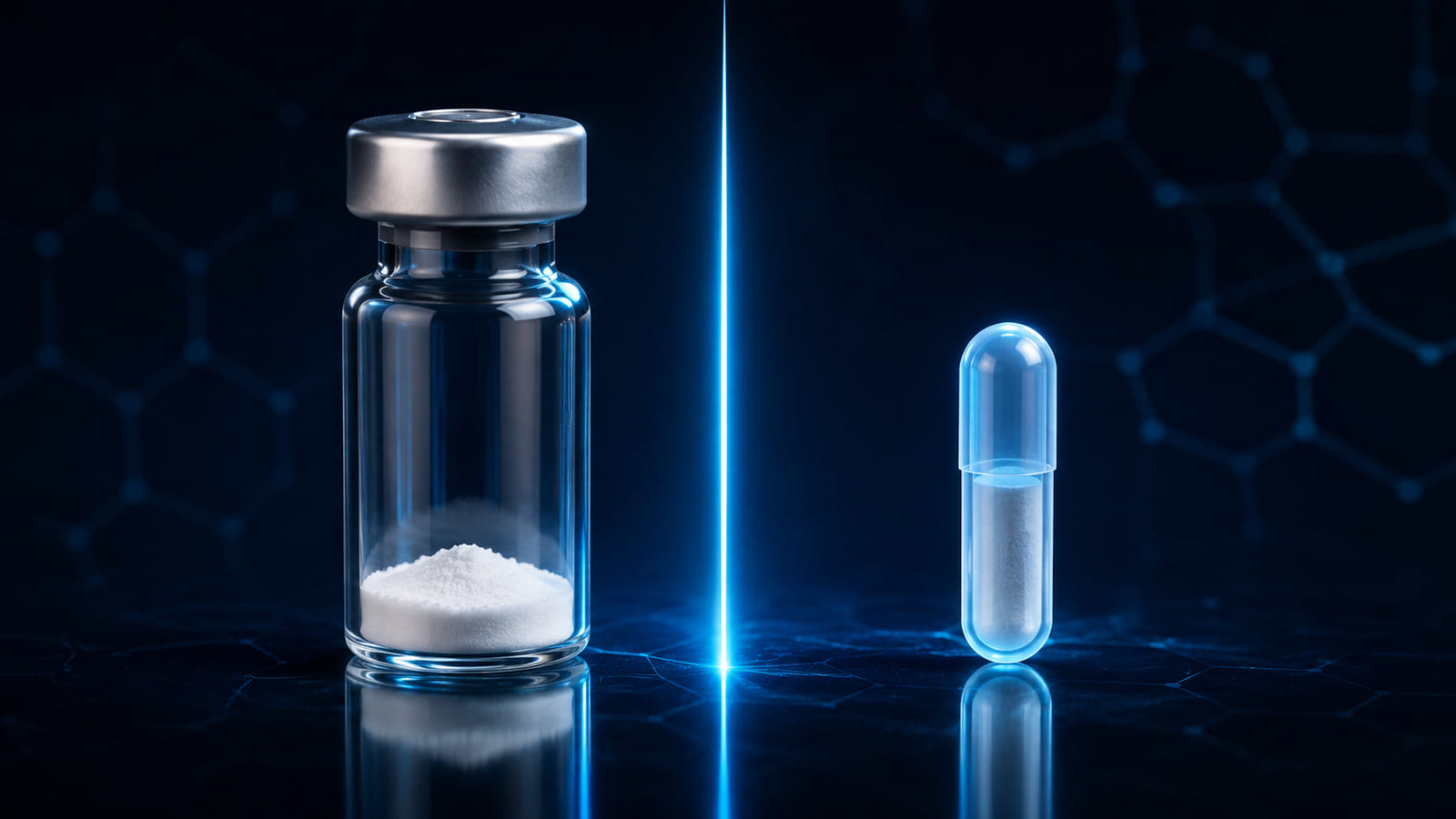
TL;DR: BPC-157 comes in two forms because it survives stomach acid, which almost no other peptide does. A lyophilised vial is freeze-dried powder you reconstitute yourself, which lets a protocol hit any target amount by setting the concentration. A capsule arrives at a fixed amount with nothing to prepare. The published animal research has used both routes; no human study has ever compared them. Everything below is research context — BPC-157 is supplied for laboratory research only, not for human consumption.
Why an Oral Form Exists at All
This is the part that surprises people, and it is worth understanding before comparing anything. Most peptides cannot be taken orally in any meaningful sense. Stomach acid and digestive enzymes take them apart long before they could do anything, which is why the peptide field is dominated by injectables.
BPC-157 is the exception, and not by accident. It was originally identified as a fragment of a protein found in human gastric juice — it comes from the stomach. The literature reports it staying intact in gastric acid for hours rather than minutes. That single property is the reason capsule forms are on the market at all.
The oral form is not a convenience shortcut someone invented. It exists because this particular peptide was found in the stomach and behaves accordingly.
What Each Form Actually Is
The two forms are less similar than the shelf suggests, and the difference is about preparation rather than the peptide itself.
A lyophilised vial — like our BPC-157 10 mg — is freeze-dried powder sealed under vacuum. Nothing can be measured until it is dissolved in a diluent, usually bacteriostatic water. How much diluent you add sets the concentration, and the concentration determines how many syringe units any target amount works out to. Our reconstitution guide covers the method and the units chart covers the conversions.
A capsule is finished at manufacture. Ours hold 500 mcg each, 100 to a bottle. There is no mixing, no concentration, no syringe, and no chart — the amount was fixed before it reached you.
The Practical Differences
Side by side, the trade-off is flexibility against simplicity.
| Lyophilised vial | Capsules | |
|---|---|---|
| Preparation | Reconstitute with diluent | None |
| Amount control | Any target, set by concentration | Fixed per capsule |
| Equipment | Syringe and bacteriostatic water | None |
| Storage | Frozen dry; refrigerated once mixed | Sealed, room temperature |
| Working life | Roughly 30 days after mixing | Shelf life of the sealed bottle |
| Chart applies? | Yes — units depend on concentration | No — amount is fixed |
The storage row is the one people underestimate. A reconstituted vial starts a clock and needs refrigeration; an unopened capsule bottle does not. For a protocol running over weeks, that difference in handling is often more decisive than anything about the peptide.
What the Research Actually Says About the Routes
Both routes are represented in the published animal work. The Zagreb group that produced most of the BPC-157 literature reported activity when the peptide was given orally — frequently in drinking water — as well as by injection. So "does the oral route do anything" is not an open question in rodents.
What is missing is everything downstream of that. No human study has characterised either route. No study has compared the two head to head in the same model at matched amounts. Bioavailability figures quoted for oral BPC-157 in marketing copy are not traceable to published human data, because that data does not exist.
This is the same evidentiary gap covered in our piece on BPC-157 side effects: a large body of animal research, and no human trial to anchor it.
Strips, Sprays and Other Formats
Sublingual strips and nasal sprays turn up in searches and in the wider market. There is no published comparative data for either against capsules or vials, and we do not supply them.
When a vendor attaches a specific absorption percentage to one of these formats, ask where the number came from. In practice it is usually a claim rather than a measurement.
Choosing Between Them for a Protocol
Framed as a research-handling question rather than advice, the decision usually comes down to two things.
- Does the protocol need a specific target amount? A reconstituted vial can hit any figure by adjusting concentration. Capsules move in fixed 500 mcg steps.
- Is the oral route itself part of the research question? Gastrointestinal models are the setting where the oral route is most represented in the literature, which is why a capsule format exists for that work.
There is also a combination capsule — BPC+KPV 500/500 mcg — pairing BPC-157 with KPV for dual-pathway gut research. On the vial side, the co-lyophilised BPC/TB blend pairs it with TB-500 instead; our synergy piece covers that pairing.
What Matters Regardless of Form
Neither format means anything if the contents were never verified. A capsule is harder to assess by eye than a vial, not easier — you cannot see the powder, and there is no way to judge fill accuracy without documentation.
Ask for the same evidence either way: a batch certificate of analysis, HPLC purity, and mass-spectrometry identity confirmation. Our testing process sets out what we publish, and the supplier guide covers what to check elsewhere. For the wider picture, see what BPC-157 is and the BPC-157 Canada overview.
For Research Use Only
Everything above describes published laboratory research and product handling. Helix North supplies BPC-157 in all formats for in-vitro and laboratory research only — not for human or veterinary consumption, and nothing here is dosing, route or medical guidance.